Evaluating Knorr Seasoning Culinary Facts provides essential technical data for B2B food buyers, commercial executive chefs, product developers, and retail category managers. Understanding the culinary science, flavor chemistry, umami synergism, salt replacement dynamics, and heat stability of Knorr seasoning products is critical when evaluating ingredient performance for commercial food production and food service distribution.
Knorr represents one of the world’s most scientifically developed culinary seasoning brands. Formulated by professional chefs and food scientists, Knorr products deliver consistent, concentrated savory profiles across high-volume kitchens and household cooking. This technical guide analyzes the chemical, physical, and sensory facts governing Knorr seasoning formulations.
Table of Contents
- The Culinary Heritage and Professional Heritage of Knorr
- Flavor Chemistry: Monosodium Glutamate, Nucleotides, and the Umami Effect
- Thermal Heat Stability and Maillard Reaction Enhancers
- Comparative Analysis of Core Knorr Flavor Lines and Ingredients
- Dietary Standards, Allergen Management, and Shelf-Life Physics
- Frequently Asked Questions (FAQ)
1. The Culinary Heritage and Professional Heritage of Knorr
Knorr was founded in Heilbronn, Germany, in 1838 by Carl Heinrich Knorr, who pioneered drying techniques to preserve taste and nutritional value in vegetables and seasonings. Over nearly two centuries, Knorr evolved from a regional soup company into a global culinary powerhouse.
Through its dedicated professional division—Unilever Food Solutions (UFS)—Knorr collaborates with over 230 in-house executive chefs to engineer products that solve operational challenges in commercial kitchens: reducing stock preparation time, standardizing flavor profiles across kitchen staff shifts, and controlling food costs per serving.
2. Flavor Chemistry: Monosodium Glutamate, Nucleotides, and the Umami Effect
The foundational secret behind Knorr’s savory performance lies in its precise application of umami synergism.
[Free L-Glutamate (MSG)]
           │
           ▼
[Receptor Binding: T1R1 / T1R3 G-Protein Complex]
           │
           ├──────────────────────────────┐
           ▼                              ▼
  [Standard Umami Signal]        [5'-Nucleotides (I+G) Added]
  (Baseline Savory Taste)                 │
                                          ▼
                                 [8x Umami Receptor Amplification]
                                 (Deep, Long-Lasting Mouthfeel)
The Umami Receptors
Umami is the Fifth Basic Taste, triggered primarily by free L-glutamate binding to T1R1/T1R3 taste bud receptors on the human tongue.
Nucleotide Synergy Mechanics
When free glutamate (MSG) is combined with purine 5′-ribonucleotides—specifically Disodium Inosinate (IMP) and Disodium Guanylate (GMP)—a conformational change occurs in the taste receptor proteins:
- Synergistic Multiplier: Combining MSG with IMP and GMP in exact ratios magnifies the perceived savory intensity up to eight times compared to using MSG alone.
- Mouthfulness and Lingering Aftertaste: This synergy extends the duration of flavor perception on the palate, creating a rich “mouthfulness” characteristic of slow-simmered bone broths.
3. Thermal Heat Stability and Maillard Reaction Enhancers
Commercial food preparation subjects seasonings to extreme heat during roasting, stir-frying, pressure cooking, and deep frying. Knorr seasonings are engineered to remain thermally stable under intense kitchen heat.

Thermal Fat Protection
Rendered chicken or beef fat used in Knorr bouillon cubes and pastes is stabilized with natural antioxidants (such as mixed tocopherols) to prevent lipid oxidation during high-heat stir-frying or prolonged soup simmering.
Maillard Reaction Precursors
Knorr seasoning powders contain controlled levels of reducing sugars and amino acid sources (hydrolyzed vegetable proteins). When exposed to pan heat above 140°C (284°F), these compounds undergo rapid Maillard browning reactions, generating complex roasted, savory aroma notes in pan juices and stir-fried meats.
4. Comparative Analysis of Core Knorr Flavor Lines and Ingredients
The following matrix compares primary functional components and culinary applications across core Knorr seasoning variants:
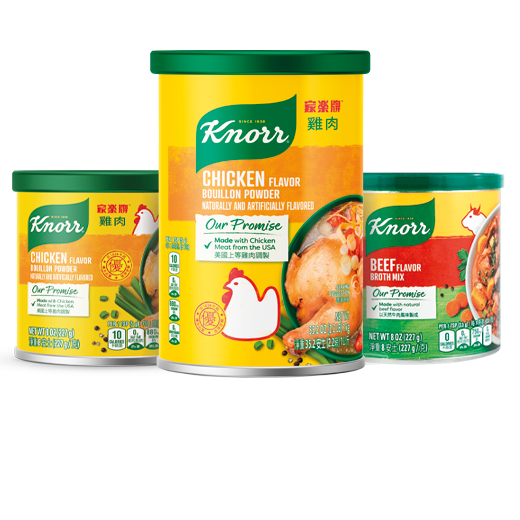
| Knorr Product Line | Primary Flavor Drivers | Key Active Ingredients | Primary Culinary Application |
| Chicken Bouillon Cubes | Chicken extract & fat, onion, parsley | MSG, Disodium Inosinate, Salt, Palm Fat | Instant clear stock, rice cooking liquid, stew bases. |
| Pork Seasoning Powder | Pork meat powder, garlic, soy sauce | MSG, I+G, Sugar, White Pepper | Meat marinades, stir-fries, noodle soup seasoning. |
| Aromat All-Purpose | Mushroom powder, onion, celery, turmeric | MSG, Salt, Lactose, Silicon Dioxide | Table seasoning, egg dishes, roasted vegetables. |
| Liquid Concentrates | Reduced meat/veg juice concentrates | Water, Salt, Yeast Extract, Xanthan Gum | Instant cold-water dispersion, pan sauces, gravies. |
| Sinigang / Sour Mix | Real tamarind fruit powder, citric acid | Tamarind Solids, MSG, Salt, Sugar | Traditional sour soups, acidic meat glazes. |
5. Dietary Standards, Allergen Management, and Shelf-Life Physics
Commercial food manufacturers and exporters must navigate strict dietary and allergen labeling parameters when specifying Knorr inventory:
- Sodium Management: Knorr seasonings contain salt as a primary carrier (typically 35% to 50% sodium chloride). Salt acts as a natural preservative and enhances umami perception. Low-sodium variants are available for institutional healthcare procurement.
- Allergen Declarations: Formulations may contain traces of wheat gluten, soy, celery, or milk derivatives depending on the specific product line. Clear labeling complies with international allergen disclosure laws.
- Factory Shelf Life: Dehydrated powders and cubes maintain an official shelf life of 18 to 24 months from production when stored below 25°C and 60% Relative Humidity.
Knorr Culinary Science FAQ
Disclaimer: Unless otherwise stated, the images used in this article are the property of their respective owners. We do not claim ownership of any third-party images featured, and they are used here strictly for informational and educational purposes. If you are the copyright holder and wish to have an image removed, please contact us.