


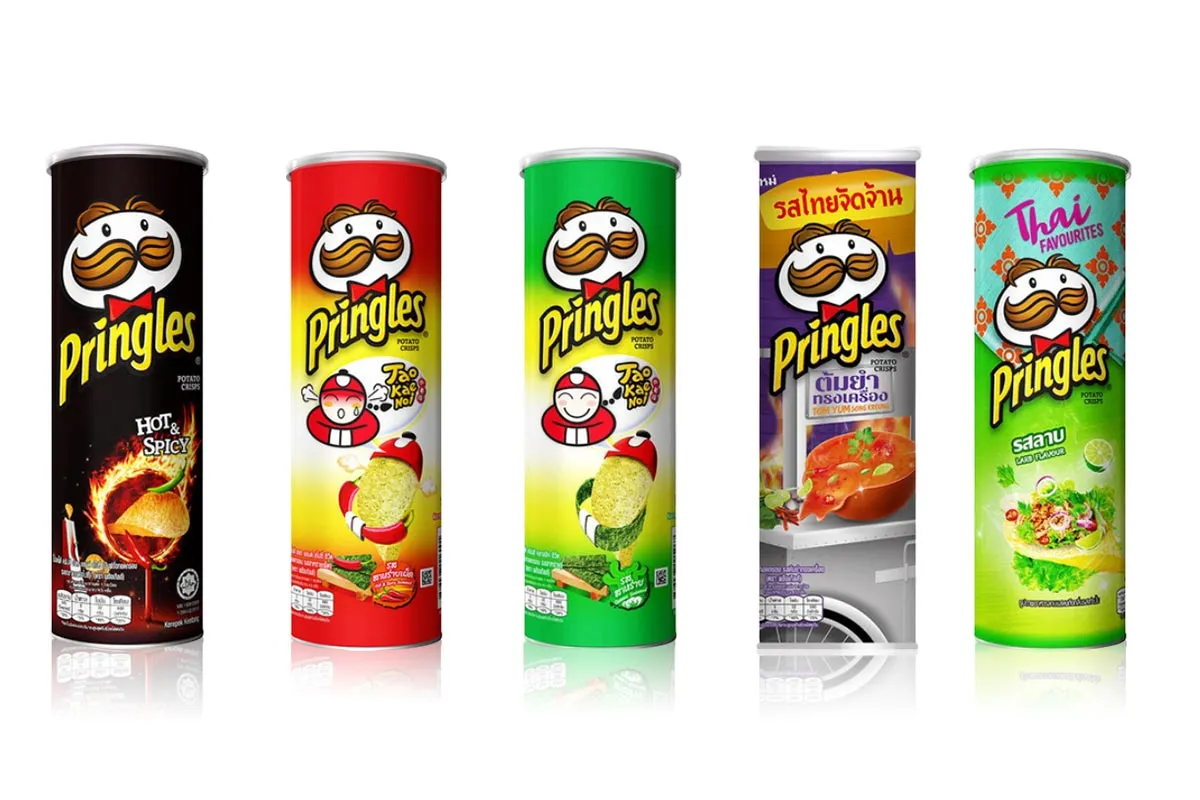
Sourcing Thai Pringles Potato Chips Wholesale inventory provides international supermarket chains, regional convenience store networks, specialized Asian grocery distributors, and FMCG trading partners with an essential, high-margin revenue engine in the fast-moving savory snack category. Manufactured under the massive global Kellanova (formerly Kellogg’s) portfolio in their advanced Southeast Asian production facilities, these highly sought-after stacked crisps are globally renowned for their uniquely Asian flavor profiles (such as Tom Yum Song Kreung, Seaweed, and Spicy Squid), distinguishing them as a highly reliable staple in the global ethnic snack market.
For B2B procurement managers and supply chain directors working with distribution partners, managing full container load (FCL) consignments of wholesale Pringles requires carefully evaluating product collection variants, specific packaging configurations (107g standard vs. 42g mini cans), master carton yields, ocean container volume limits, and international food safety clearance protocols. This technical guide evaluates the operational, financial, and logistical frameworks necessary to establish a highly profitable import and distribution model for these globally demanded snacks.

Table of Contents
- Global Market Demand for Asian Pringles
- Product Portfolio Breakdown
- Savory Snack Manufacturing Chemistry
- Packaging Configurations and Freight Density
- B2B Sourcing Pathways for Thai Pringles Potato Chips Wholesale
- Landed Cost and Gross Margin Calculation Framework
- Import Compliance, Harmonized System Codes, and Customs Documentation
- Conclusion
Global Market Demand for Asian Pringles
The global savory snack market is undergoing a significant expansion, heavily driven by consumer demand for affordable, highly flavorful, and culturally diverse snacking options. The unique regional flavors of Thai-manufactured Pringles command a fiercely loyal market share across Asia and offer massive export potential due to the viral popularity of Asian snacks in Western and European cosmopolitan markets.
Growth Drivers in the Market
The exponential growth in the Asian snack sector is driven by shifting consumer palates and social media trends. Consumers consistently pivot toward established, recognizable legacy brands (like Pringles) that offer novel, adventurous flavors. The robust, highly specific flavor profiles appeal to traditional Asian snack consumers while simultaneously capturing younger demographics eager for unique tasting experiences.
Commercial Advantages
Adding this inventory to a B2B distribution catalog delivers distinct commercial advantages:
- Unmatched Brand Authority: Backed by Kellanova’s massive global brand recognition, generating immediate pre-sold consumer trust and rapid retail velocity.
- High Impulse Purchase Velocity: The novel Thai flavors drive immense curiosity and daily recurring repurchase frequency in convenience channels.
- Premium Import Margin Value: Because the Southeast Asian FMCG supply chain is highly optimized, the Free On Board (FOB) acquisition costs are extremely competitive, yielding excellent gross profit margins per ocean container.
Product Portfolio Breakdown
Curating an optimal inventory mix requires selecting the right combination of flavors tailored to target consumer consumption habits and retail demographics.
Core Product SKUs
When structuring a container load, these core SKUs form the foundation of any successful procurement strategy:
- Traditional Thai Flavors: The flagship regional format, led by incredibly popular profiles like Tom Yum Soup and Sweet Chili. These chips offer a complex, sour-and-spicy taste that is highly sought after in international markets.
- Seafood Flavors: Heavily targeting the Asian savory snacking demographic, featuring intense profiles like Spicy Squid and Grilled Seaweed.
- Standard Export Flavors: Standardized global staples like Sour Cream & Onion or Original, manufactured at competitive Southeast Asian price points for broader distribution.
Savory Snack Manufacturing Chemistry
The formulation found in these products achieves its signature uniform crunch and deep flavor retention through an engineered manufacturing matrix combining premium potato flakes, specialized frying oils, and complex regional seasonings.

The Dough and Frying Process
Unlike traditional sliced potato chips, Pringles are manufactured using a highly advanced dough-extrusion process. The signature texture is derived from a uniform dough made of dehydrated potato flakes, corn flour, and wheat starch. This dough is rolled into a thin sheet, cut into uniform ovals, and pressed into their iconic hyperbolic paraboloid (saddle) shape before passing through a continuous fryer. They are precisely seasoned and uniformly stacked into their protective tubes.
Packaging Configurations and Freight Density
When managing ocean shipments, physical logistics heavily dictate profitability. Products are packaged in rigid, foil-lined cardboard cylinder tubes, sealed with foil, capped with plastic, consolidated into master cases, and palletized to withstand rigorous maritime transit.
Master Carton Yields
Understanding the exact packing specifications is critical for calculating freight costs:
| Packaging SKU Format | Standard Fill Volume | Retail Pack Format | Master Carton Packing | Primary Distribution Channel |
| Standard Can | ~107g | Rigid Cardboard Tube | 12 Tubes / Carton | Supermarkets & Convenience |
| Mini Grab-and-Go | ~42g | Rigid Cardboard Tube | 12 Tubes / Carton | Convenience Stores & Vending |
B2B Sourcing Pathways for Thai Pringles Potato Chips Wholesale
Commercial buyers access wholesale inventory through two primary procurement channels, depending on their capital flexibility and volume requirements.
FMCG Consolidator Options
Independent wholesalers, mid-tier regional distributors, and agile import firms typically source via master FMCG consolidators operating out of major export hubs in Thailand or Malaysia. Consolidators offer highly flexible Minimum Order Quantities (MOQs starting at a single 40ft High Cube container) and highly valuable mixed-container capabilities.
Landed Cost and Gross Margin Calculation Framework
Procurement teams must accurately forecast their financials before executing a purchase order. Calculating net landed unit costs involves applying a structured, multi-step financial calculation process.
Step-by-Step Financial Breakdown
- Step 1: Calculate Ocean Freight Charges (based on volumetric weight, as tubes cube out containers) + Origin Port Fees + Import Customs Duties + Marine Cargo Insurance + Local Destination Drayage.
- Step 2: Add the Total Shipping Overhead to the Free On Board (FOB) Purchase Carton Price.
- Step 3: Divide the Total Landed Cost per Master Carton by the number of Retail Tubes to find the exact unit cost.
Import Compliance, Harmonized System Codes, and Customs Documentation
Clearing food imports through international customs is a highly regulated process. Securing your shipments requires flawless documentation verified by accredited origin testing laboratories.
Essential Export Documentation Suite
- Commercial Shipping Documents: Master Bill of Lading (B/L), Commercial Invoice, Detailed Packing List, and a Certificate of Origin (COO).
- Harmonized System Classification: For customs declaration, these snack products are generally classified under HS Code 1905.90 (Bread, pastry, cakes, biscuits and other bakers’ wares) or 2005.20 depending on the starch-to-potato ratio interpretation by local customs.
Conclusion
Mastering the procurement of these iconic regional snacks is the definitive key to understanding unstoppable global retail velocity in the savory category. From the precise application of bold Thai seasonings to the meticulous engineering of the crush-proof packaging formats, every single element is designed to deliver a premium, highly satisfying crunch. For international distributors and FMCG retailers, stocking these authentic flavors guarantees access to a highly loyal consumer base. Contact your preferred procurement partner today to secure your wholesale allocation of Thai Pringles Potato Chips Wholesale and optimize your snack food supply chain.
Wholesale Thai Pringles FAQ
Disclaimer: Unless otherwise stated, the images used in this article are the property of their respective owners. We do not claim ownership of any third-party images featured, and they are used here strictly for informational and educational purposes. If you are the copyright holder and wish to have an image removed, please contact us.











