The Monster Energy Origin story is one of the most remarkable transformations in the modern beverage industry. Long before it became a global lifestyle brand represented by the iconic neon-green claw, the foundation of this empire began under a completely different guise. By studying how a humble family-run juice business evolved into an international energy powerhouse, distributors and retailers can gain priceless insights into market adaptation and brand positioning.
Understanding this history is not just an academic exercise; it highlights how the beverage sector adapts to shifting consumer demands. Today, Monster Energy dominates shelves globally, but its journey was paved with strategic pivots, masterclass distribution deals, and an unconventional marketing strategy that defied standard corporate playbooks.
- The Historical Roots: Hansen’s Natural and the Monster Energy Origin
- The 2002 Pivot: How the Monster Energy Origin Redefined Energy Drinks
- Deciphering the Monster Energy Origin Ingredients and Formulation
- Tactical Marketing: Fueling the Monster Energy Origin Growth
- Global Scaling and Monster Energy Origin Distribution Networks
- Conclusion: The Legacy of the Monster Energy Origin

The Historical Roots: Hansen’s Natural and the Monster Energy Origin
To trace the true Monster Energy Origin, we must look back to 1935. In Southern California, Hubert Hansen and his three sons began selling fresh, unpasteurized fruit juices to local film studios and retailers. Operating under the name Hansen’s Fruit Juices, the business gained a solid reputation for quality and purity. Over the decades, the brand expanded into natural sodas and sparkling beverages. This established a deep-seated legacy in the American liquid market, yet the company remained relatively modest in scale.
In the late 1980s, the company faced bankruptcy and was acquired by California CoPackers Corporation, eventually becoming Hansen Natural Corporation under the leadership of South African entrepreneurs Rodney Sacks and Hilton Schlosberg in 1992. Sacks and Schlosberg recognized that the traditional juice and natural soda market had limited growth potential due to intense competition from giants like Coca-Cola and Pepsi. They began scanning the horizon for disruptive trends. This critical pivot laid the groundwork for what would soon become the global Monster Energy Origin.
The 2002 Pivot: How the Monster Energy Origin Redefined Energy Drinks
By the early 2000s, the energy drink landscape was dominated by Red Bull, which had introduced the concept of functional energy to Western consumers using a slim, 8.3-ounce can. Hansen Natural had previously experimented with smaller energy drinks like “Hansen’s Energy” but achieved minimal success. They realized that to compete, they needed a radical product concept.
In April 2002, Hansen Natural officially launched Monster Energy. The launch shattered industry norms in two primary ways: size and attitude. Instead of the standard 8-ounce can, Monster was packaged in a massive, 16-ounce black can, offering double the volume for the same retail price. The message was clear: “Go big or go home.”

The brand identity was equally aggressive. They abandoned the clean, health-focused aesthetic of Hansen’s juice products in favor of an edgy, counter-culture persona. The iconic “claw tear” logo, designed by McLean Design, resembled a scratch from a monstrous beast, forming three vertical green lines that doubled as the letter “M.” This bold branding completed the transition from a gentle juice producer to a high-octane lifestyle movement, cementing the Monster Energy Origin as a watershed moment in beverage history.
Deciphering the Monster Energy Origin Ingredients and Formulation
Beyond the striking visual packaging, the drink’s interior composition was carefully engineered to maximize sensory appeal and physical stimulation. The formulation combined a massive hit of caffeine with a proprietary energy blend containing taurine, panax ginseng, L-carnitine, and B-complex vitamins.
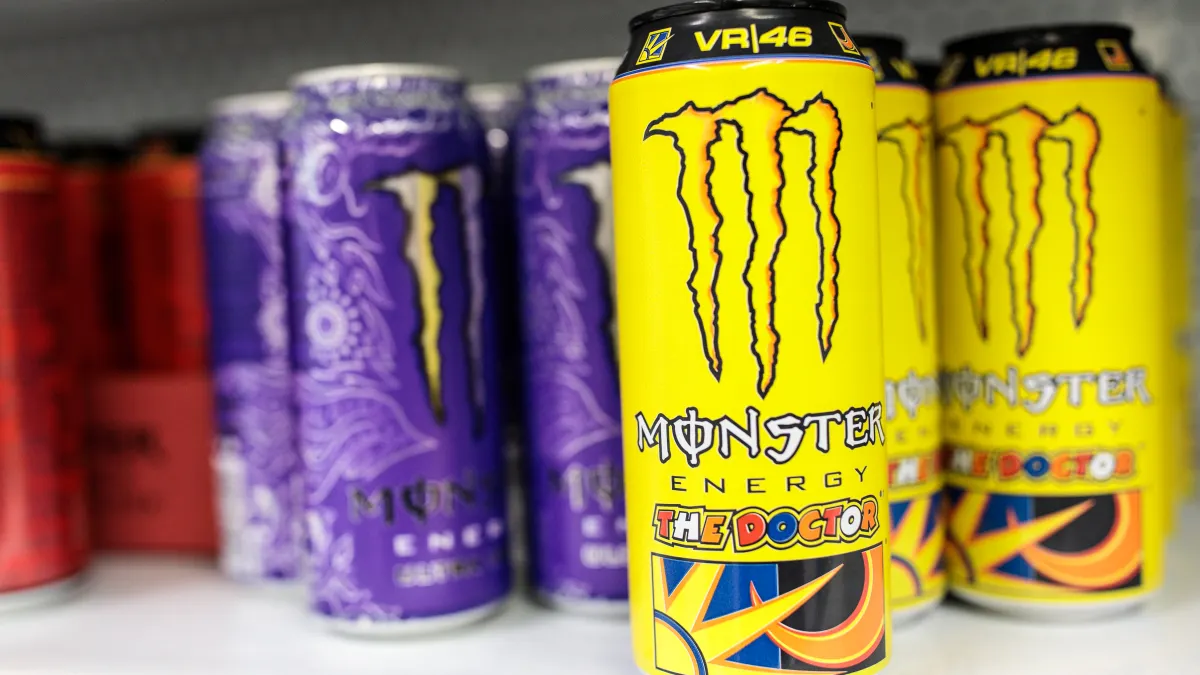
The flavor profile was also designed to be highly palatable. Unlike early competitors that had a distinct medicinal taste, the original Monster Energy offered a sweeter, carbonated punch that appealed directly to a younger demographic. This exact formulation balance of caffeine and taste remains the core driver of the brand’s enduring consumer loyalty. Let’s compare how this formulation stacked up against its key market rivals at the time of its explosive growth:
| Product | Standard Can Size | Caffeine Content | Key Ingredients |
|---|---|---|---|
| Monster Energy (Original) | 16 oz (473 ml) | 160 mg | Taurine, Ginseng, L-Carnitine, B Vitamins, Guarana |
| Red Bull | 8.4 oz (250 ml) | 80 mg | Taurine, Caffeine, B Vitamins, Alpine Spring Water |
| Rockstar Energy | 16 oz (473 ml) | 160 mg | Taurine, Ginkgo Biloba, Ginseng, Milk Thistle |
Tactical Marketing: Fueling the Monster Energy Origin Growth
A product is only as good as its reach, and the team behind Monster Energy recognized that traditional media channels were inefficient for their core demographic. Instead of spending millions on television commercials, radio spots, and billboards, the brand invested its capital directly into grassroots communities, action sports, and high-adrenaline sponsorships.
By aligning itself with motocross, skate, surf, BMX, and eventually Formula 1 and esports, Monster created an authentic lifestyle connection with its consumers. Fans didn’t just drink Monster; they wore the apparel, plastered the stickers on their vehicles, and associated the brand with their favorite athletes. This lifestyle-centric marketing model proved incredibly cost-effective, allowing the brand to reinvest heavily in its operational infrastructure and expand its product pipeline.
Global Scaling and Monster Energy Origin Distribution Networks
As demand surged, Hansen Natural Corporation faced a massive logistical challenge: scaling production and distribution to meet international demand. The beverage market is notoriously brutal for independent players who struggle to secure valuable shelf space in major supermarkets, convenience stores, and international locations.

Recognizing this, the brand consolidated its global efforts. In 2012, the Hansen Natural Corporation officially changed its name to Monster Beverage Corporation, reflecting the fact that the flagship energy drink now represented the vast majority of its revenues. The defining moment in their distribution strategy came in 2015 when Monster entered into a landmark strategic partnership with The Coca-Cola Company. Under this agreement, Coca-Cola acquired a 16.7% stake in Monster and transferred its own energy drink portfolio to Monster, while Monster transferred its non-energy brands (like Hansen’s juices and sodas) back to Coca-Cola.
Most importantly, this transaction integrated Monster into Coca-Cola’s unparalleled global bottling and distribution system. For distributors, retailers, and wholesalers, this integration changed everything. Optimizing Monster Energy wholesale distribution became highly streamlined, allowing the brand to penetrate deep into emerging markets across Europe, Asia, and Latin America. Today, wholesalers leverage this powerful network to secure bulk supplies, ensuring that shelves remain stocked with the world’s most sought-after energy drink. For deep strategic insights into global markets, business analysts often review Bloomberg’s business reports to trace operational expansions.
Conclusion: The Legacy of the Monster Energy Origin
The journey from a small California juice operation to a global powerhouse is a testament to strategic risk-taking, brilliant product positioning, and distribution mastery. By breaking the mold of traditional beverage sizes, embracing a raw counter-culture identity, and leveraging a massive corporate partnership with Coca-Cola, the company redefined consumer expectations. In summary, understanding the Monster Energy Origin allows us to see how a simple product shift can capture the cultural zeitgeist and build a multi-billion-dollar liquid empire. For wholesalers and retailers looking to capitalize on this legacy, securing reliable inventory through optimized distribution pipelines remains the key to meeting the insatiable global thirst for energy.