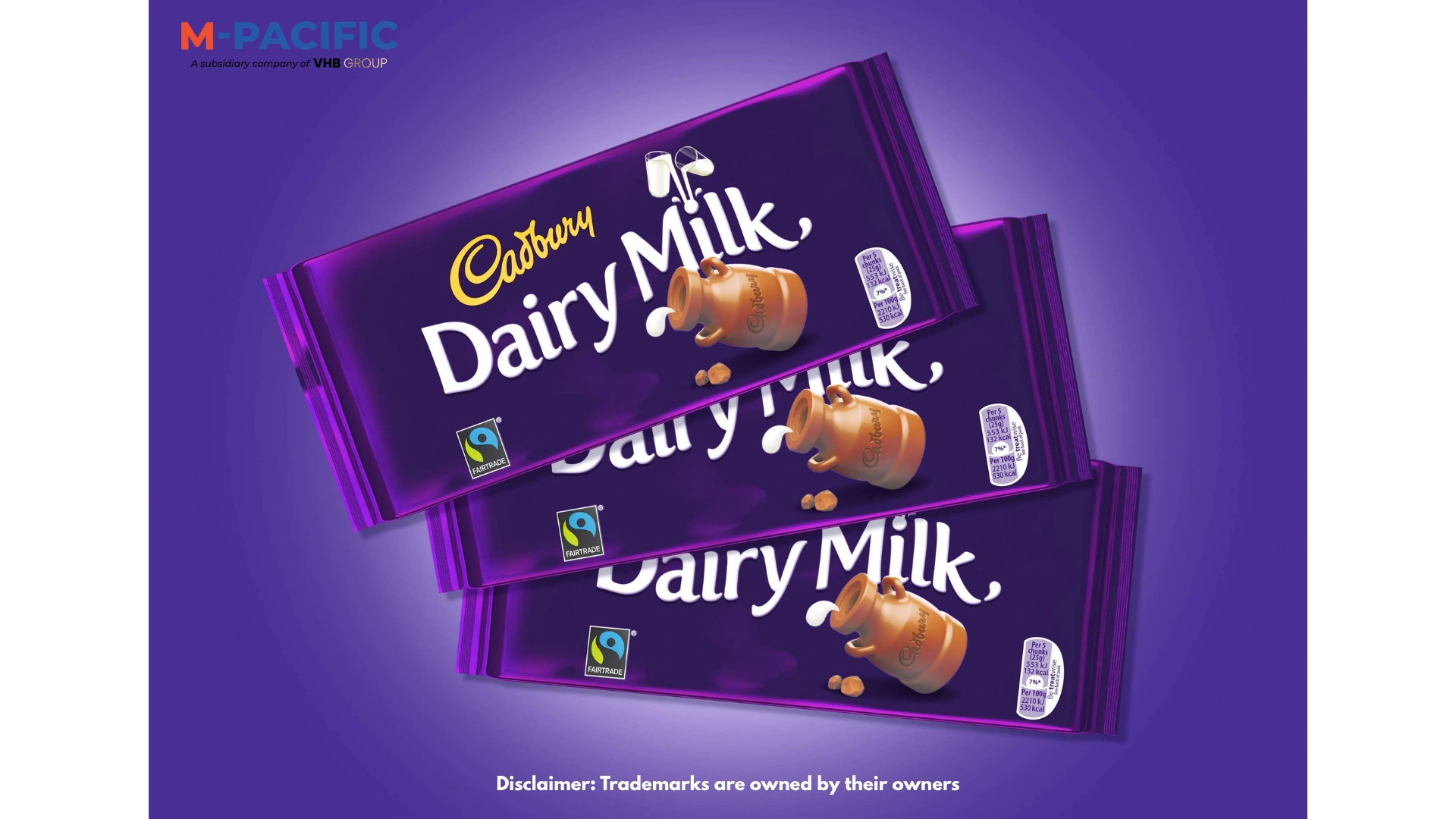
Sourcing Cadbury Dairy Milk Chocolate Bulk inventory provides international B2B confectionery distributors, supermarket chains, cash-and-carry wholesalers, duty-free operators, and FMCG trading partners with a high-velocity revenue engine in the global chocolate confectionery category. Manufactured by Mondelēz International—one of the world’s premier snack and confectionery conglomerates—Cadbury Dairy Milk stands as an iconic global benchmark for milk chocolate, celebrated for its signature “glass and a half of pure full-cream milk” formulation and creamy texture.
For B2B procurement directors and supply chain managers working with trading consolidators like M-Pacific, managing full container load (FCL) consignments of wholesale Cadbury chocolate requires navigating complex temperature-controlled logistics, humidity protection, seasonal trade cycles, and customs clearance protocols. This technical guide evaluates the operational, financial, and logistical frameworks necessary to build a highly profitable distribution model.
Table of Contents
- Global Market Demand and Commercial Positioning of Wholesale Cadbury
- Product Portfolio Breakdown: Standard Bars, Share Packs, and Inclusions
- Lipid Crystallization Science, Fat Bloom Physics, and Temperature Sensitivity
- Packaging Configurations, Container Payload Yields, and Cold-Chain Logistics
- B2B Sourcing Pathways: Mondelēz Anchor Supply vs. FMCG Consolidators
- Landed Cost and Gross Margin Calculation Framework
- Import Compliance, Customs Clearance, and HS Code Breakdown
- Frequently Asked Questions (FAQ)
1. Global Market Demand and Commercial Positioning of Wholesale Cadbury
The global chocolate confectionery market continues to expand steadily, driven by rising consumer demand for premium everyday indulgence, seasonal gifting, and impulse self-treats. Cadbury Dairy Milk commands a dominant market share across the United Kingdom, Ireland, Australia, India, South Africa, Southeast Asia, and the Middle East.
Adding bulk Cadbury Dairy Milk inventory to a B2B distribution catalog delivers distinct commercial advantages:
- Unmatched Pre-Sold Brand Authority: Over a century of global brand heritage and multi-million dollar marketing campaigns generate continuous consumer pull, reducing promotional costs for regional wholesalers.
- Rapid Cash Conversion: As a daily impulse confectionery commodity, Cadbury stock moves rapidly through modern trade hypermarkets, convenience forecourts, and travel retail outlets.
- High Sales Value Density: Premium mass positioning commands strong retail selling prices relative to physical cube volume, yielding excellent gross profit margin density per ocean shipping container.
2. Product Portfolio Breakdown: Standard Bars, Share Packs, and Inclusions
Curating an optimal product mix requires selecting the right combination of Cadbury Dairy Milk variants tailored to target consumer demographics and regional palate preferences:
Core Milk Chocolate Lines
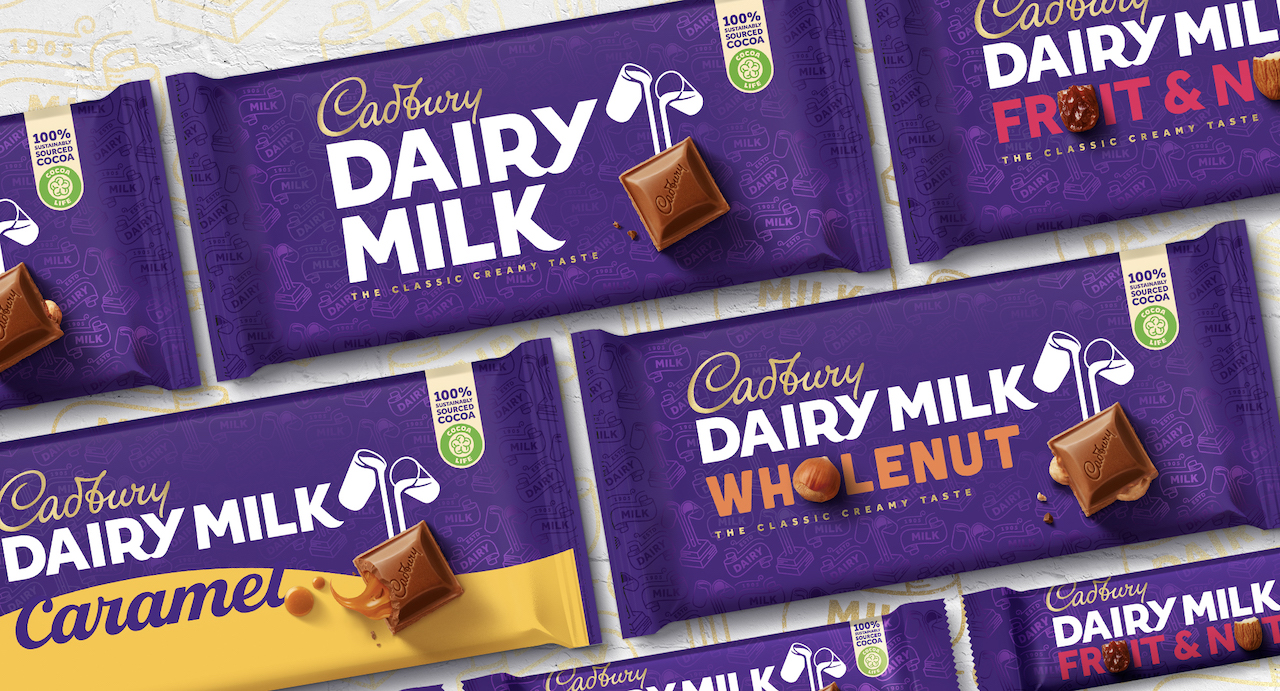
- Cadbury Dairy Milk Original: The classic flagship bar formulated with rich milk solids, cocoa butter, and cocoa mass, delivering a distinct smooth, creamy mouthfeel.
- Cadbury Dairy Milk Fruit & Nut: Infused with crunchy toasted almonds and plump raisins, providing texture contrast and high impulse appeal.
- Cadbury Dairy Milk Roast Almond / Hazelnut: Packed with whole or chopped roasted nuts, serving price-insensitive nut-chocolate lovers.
Innovative Inclusions and Texture Extensions
- Cadbury Dairy Milk Marvelous Creations: Incorporates popping candy, jelly jellies, and micro-candy coated gems within milk chocolate, driving high engagement among younger shoppers.
- Cadbury Dairy Milk Oreo: Combines classic Dairy Milk chocolate with crunchy Oreo biscuit pieces and vanilla cream filling, leveraging Mondelēz’s cross-brand power.
3. Lipid Crystallization Science, Fat Bloom Physics, and Temperature Sensitivity
Chocolate is a delicate emulsion of cocoa solids, sugar, and milk fat suspended within a crystalline cocoa butter matrix. Managing chocolate during ocean transit requires strict thermal control.
[Melted Liquid Cocoa Butter Fat]
               │
               ▼
[Controlled Tempering Phase (Form V Crystals)] ──► Yields Glossy Shine & Crisp Snap
               │
               ▼
[Exposure to Heat (> 28°C / 82°F)]             ──► Form V Crystals Melt & Disruption
               │
               ▼
[Cooling & Recrystallization (Fat Bloom)]      ──► White Dull Streaks & Waxy Texture
Cocoa Butter Polymorphism (Form V Crystal Matrix)
Cocoa butter can crystallize into six different polymorphs (Forms I through VI). High-quality Cadbury chocolate is tempered to lock cocoa butter into the stable Form V (Beta) crystal structure, which provides a glossy visual appearance, firm snap, and smooth body-temperature melt (34°C / 93°F).
Thermal Exposure and Fat Bloom
When ambient shipping temperatures exceed 28°C (82°F), Form V cocoa butter crystals melt and migrate to the surface of the bar. Upon cooling, the fat recrystallizes into the unstable Form VI structure, creating a dull white, powdery film known as fat bloom. While bloomed chocolate is medically safe to consume, it loses its visual appeal and crisp snap, making it commercially unsaleable.
4. Packaging Configurations, Container Payload Yields, and Cold-Chain Logistics
Selecting the appropriate packaging format and ocean shipping method directly governs freight yield and product protection.
| Packaging SKU Format | Standard Bar Weight | Master Unit Packing | Payload per 20ft Reefer FCL | Primary Distribution Channel |
| Impulse Single Bar | 45g / 50g / 60g | 48 or 72 Bars / Case | 1,600 – 1,800 Cases (~12.5 Tons) | Convenience Stores & Vending |
| Medium Retail Bar | 150g / 180g / 200g | 24 or 36 Bars / Case | 1,400 – 1,600 Cases (~13.8 Tons) | Supermarkets & Pharmacies |
| Family Block Bar | 300g / 350g | 12 or 16 Bars / Case | 1,200 – 1,400 Cases (~14.5 Tons) | Hypermarkets & Wholesale Clubs |
| Gift / Share Pack | 150g – 250g Pouch | 12 Pouches / Case | 1,200 – 1,500 Cases (~11.0 Tons) | Duty-Free & Seasonal Display |
Refrigerated Container (Reefer) Mandatory Protocol
Because ocean vessels crossing tropical equatorial sea routes experience internal container temperatures exceeding 45°C (113°F), Cadbury chocolate must be shipped in active Refrigerated Containers (Reefers) set precisely between 14°C and 18°C (57°F to 64°F) with Relative Humidity maintained below 65% RH.
5. B2B Sourcing Pathways: Mondelēz Anchor Supply vs. FMCG Consolidators
Commercial buyers access wholesale Cadbury inventory through two primary procurement channels:
Direct Mondelēz International Contracts
Enterprise distributors establish direct annual purchasing agreements with regional Mondelēz manufacturing divisions (e.g., Mondelēz UK, Mondelēz Australia, or Mondelēz India).
- Advantages: Lowest factory-gate pricing, direct access to fresh manufacturing lots, customized promotional allowance support, and guaranteed supply continuity.
- Trade-Offs: Requires massive annual volume commitments (typically 5+ FCLs monthly) and strict territorial distribution restrictions.
FMCG Export Consolidators
Independent wholesalers source via master FMCG consolidators like M-Pacific.
- Advantages: Flexible Minimum Order Quantities (MOQs starting at 1x20ft Reefer FCL) and mixed-container capabilities (combining Cadbury with Slide Chips, Cosy Biscuits, or Halls Mints).

6. Landed Cost and Gross Margin Calculation Framework
Procurement teams calculate net landed unit costs across ocean shipping lanes by applying a structured calculation sequence:
- Step 1: Determine Total Shipping Overhead = Ocean Reefer Freight Charges + Import Customs Duties + Marine Insurance Premiums + Local Port Drayage & Cold Storage.
- Step 2: Calculate Landed Cost per Master Case = Free On Board (FOB) Purchase Case Price + (Total Shipping Overhead / Total Cases Loaded).
- Step 3: Calculate Landed Cost per Saleable Unit = Total Landed Cost per Master Case / Saleable Units per Case (e.g., 24 bars).
- Step 4: Calculate Net Profit Margin Percentage = [(Target Wholesale Unit Selling Price – Landed Unit Cost) / Target Wholesale Unit Selling Price] x 100.
7. Import Compliance, Customs Clearance, and HS Code Breakdown
Clearing confectionery imports through international customs requires complete documentation verified by accredited origin testing laboratories.
Essential Export Documentation Suite
- Commercial Documentation: Master Bill of Lading (B/L), Commercial Invoice, Detailed Packing List, and Certificate of Origin (COO).
- Quality & Food Safety Certificates: Batch Certificate of Analysis (CoA) detailing fat content, moisture, and microbiological sterility.
- Religious & Dietary Compliance: Halal Certification or Kosher Certification depending on target market laws.
- Harmonized System Classification: Classified under HS Code 1806.32.00 (Chocolate and other food preparations containing cocoa, in blocks, slabs or bars, filled) or HS Code 1806.31.00 (Not filled).
Cadbury Dairy Milk Bulk Sourcing FAQ
Disclaimer: Unless otherwise stated, the images used in this article are the property of their respective owners. We do not claim ownership of any third-party images featured, and they are used here strictly for informational and educational purposes. If you are the copyright holder and wish to have an image removed, please contact us.